
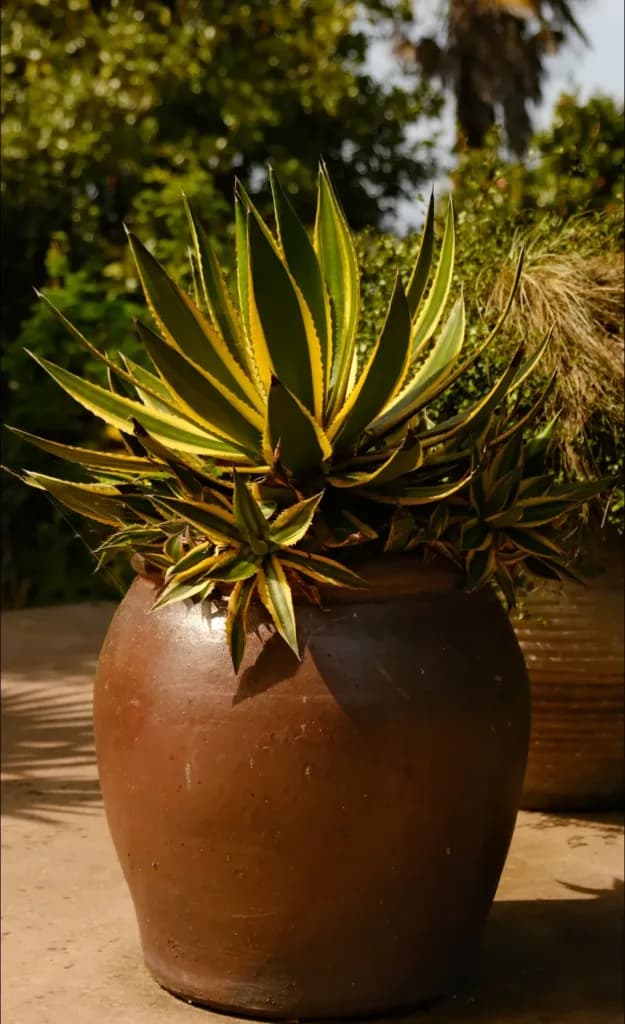
The agave amarillo is a large, perennial succulent plant, highly valued in landscaping for its striking rosette of fleshy leaves. Its leaves are rigid and end in a thorny point, characterized by a grayish-green color in the center with wide, vibrant yellow margins. This variegated variety brings exceptional architectural brightness to low-water gardens and large pots.
Botanically, it belongs to the Asparagaceae family and is native to the arid and semi-arid regions of North America, especially Mexico. It is a species adapted to extreme conditions of drought and intense heat, storing water in its thick leaf fibers. Its edges have small, curved teeth that act as natural defense, so it should be placed away from frequently used areas to avoid accidental punctures.
In home cultivation, it is one of the most resistant and easy-to-maintain succulents, ideal for beginners. A fascinating characteristic is its monocarpic nature: the plant lives for many years accumulating energy until it produces a single, immense flower stalk that can reach several meters in height. After this spectacular flowering, the mother plant dies, but it usually leaves numerous basal shoots that ensure the continuity of the species.
Did you know?Several basal "pups" or shoots are observed in the pot; you can separate them with roots to obtain new plants.
Care
- Watering
- Scarce, every 15-20 days in summer, none in winter. Allow soil to dry out.
- Light
- Full direct sun, minimum 6 hours daily to maintain color.
- Temperature
- Warm climates; tolerates light occasional frost down to -5°C.
- Soil
- Very well-draining, cactus mix with silica sand or pumice.
- Fertilizer
- Optional, very diluted succulent fertilizer once in spring.
- Pruning
- No routine pruning is necessary other than trimming away dried or damaged lower leaves using heavy-duty, sanitized shears. Wear thick protective gloves and eye protection when working near the dangerous terminal spines.
- Propagation
- Propagate effortlessly by detaching the offshoots, known as pups, that sprout abundantly around the base of the parent rosette. Allow the separated suckers to callous over in a dry spot for a few days before planting them in gritty soil.
Is agave amarillo toxic to cats and dogs?
The ASPCA doesn't list this species. If your pet has chewed it and seems unwell, call your vet.
Common problems
- Root rot
- Overwatering
- Mealybugs and scale
- Cold damage
Gallery
Frequently asked questions
Why are the lower leaves turning yellow or soft?
Soft, discolored leaves are almost always a sign of overwatering or poor soil drainage, which rapidly causes root rot. Stop watering immediately, remove any mushy foliage, and ensure the soil dries out completely between waterings.
Does it really take a century to flower?
No, the plant rarely takes a hundred years and usually flowers between 10 and 30 years depending on the climate and energy stored. Once the impressive flower stalk blooms, the mother plant will die, leaving behind numerous healthy offsets.
Can it be grown as an indoor houseplant?
It is generally unsuited for indoor living because it demands intense direct sunlight and plenty of airflow to stay healthy. Only juvenile specimens in pots should be kept near exceptionally bright, south-facing windows before being moved outside.
How do I remove and replant the pups?
Carefully dig around the baby offset to sever its connecting runner with a clean, sharp knife, preserving as many of its own roots as possible. Let the cut callous in the shade for two to three days before potting it in dry, fast-draining cactus mix.
From the same family
Growing agave amarillo at home?
Take a photo and we'll tell you how it's doing and what it needs.