
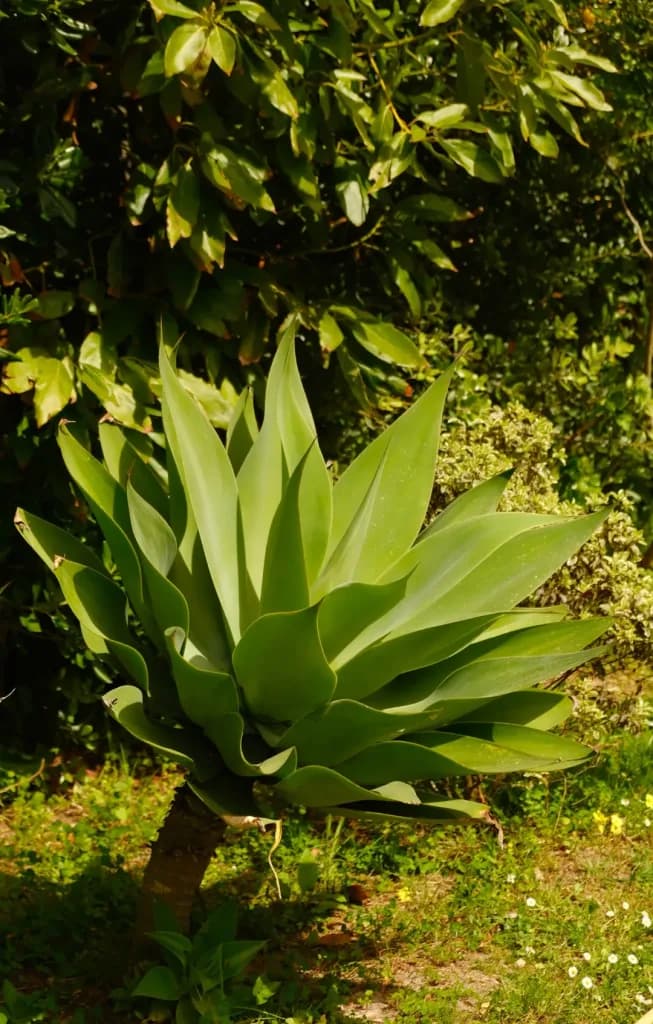
The Foxtail Agave is a succulent highly valued in landscaping for its elegant, sculptural appearance and the absence of the sharp thorns typical of its genus. Its leaves are wide, soft to the touch, and pale green or glaucous, arranged in a compact rosette that, over time, rises on a thick, woody stem. It is popularly known as "foxtail agave" due to the curved shape of its spectacular inflorescence.
Belonging to the Asparagaceae family, this species is native to the mountainous regions of central Mexico, where it grows on rocky slopes at high altitudes. It is a relatively fast-growing plant compared to other agaves and has the peculiarity of being monocarpic: it flowers only once after many years of life, and then the main rosette dies, leaving behind numerous offsets at its base.
It is widely cultivated in gardens in temperate and Mediterranean climates due to its great drought resistance and low maintenance. It is an extremely versatile plant that performs well in both large pots and the ground, adding an exotic and tropical touch. Although it prefers full sun, it tolerates partial shade well, allowing it to be grown indoors in very bright conditions.
Did you know?Unlike other agaves, this species has no thorns on its leaf margins, making it ideal for high-traffic areas or gardens with children and pets.
Care
- Watering
- Every 15 days in summer; monthly in winter. Allow substrate to dry completely.
- Light
- Full sun or very bright semi-shade. Requires at least 6 hours of light.
- Temperature
- Ideal between 15-28°C. Protect from intense frosts below 0°C.
- Soil
- Specific succulent mix with excellent drainage and some coarse sand.
- Fertilizer
- Diluted cactus fertilizer every 4 weeks during spring and summer.
- Pruning
- No formal pruning is required except for clearing away spent lower leaves as they dry out naturally. Trim dry foliage close to the stem using clean, sharp pruning shears.
- Propagation
- Propagate by harvesting the basal offsets, known as pups, that develop around the parent stem. Allow the cut ends to callous over for a few days before potting them in dry, gritty soil.
Is Foxtail Agave toxic to cats and dogs?
The ASPCA doesn't list this species. If your pet has chewed it and seems unwell, call your vet.
Common problems
- Root rot
- Overwatering
- Cold damage
- Sunburn
Gallery
Frequently asked questions
Why are the leaves wrinkling or drooping?
Wrinkled or limp foliage typically indicates prolonged underwatering or root issues preventing moisture uptake. Check the soil moisture; if it is completely dry, give the root ball a deep soak.
Can foxtail agave be grown indoors?
Yes, provided it is placed in an unobstructed south- or east-facing window that receives several hours of bright direct sun. Without adequate light, the rosette will stretch and lose its compact, sculptural form.
Does foxtail agave die after flowering?
The main rosette is monocarpic and naturally dies after it finishes blooming, which can take up to ten years. Fortunately, the plant typically leaves behind abundant basal pups that continue growing in its place.
Why are dark spots appearing on the foliage?
Black or brown blemishes are usually caused by sudden sunburn after moving the plant or fungal issues linked to overwatering. Ensure the pot drains freely and let the soil dry out between waterings.
From the same family
Growing Foxtail Agave at home?
Take a photo and we'll tell you how it's doing and what it needs.