
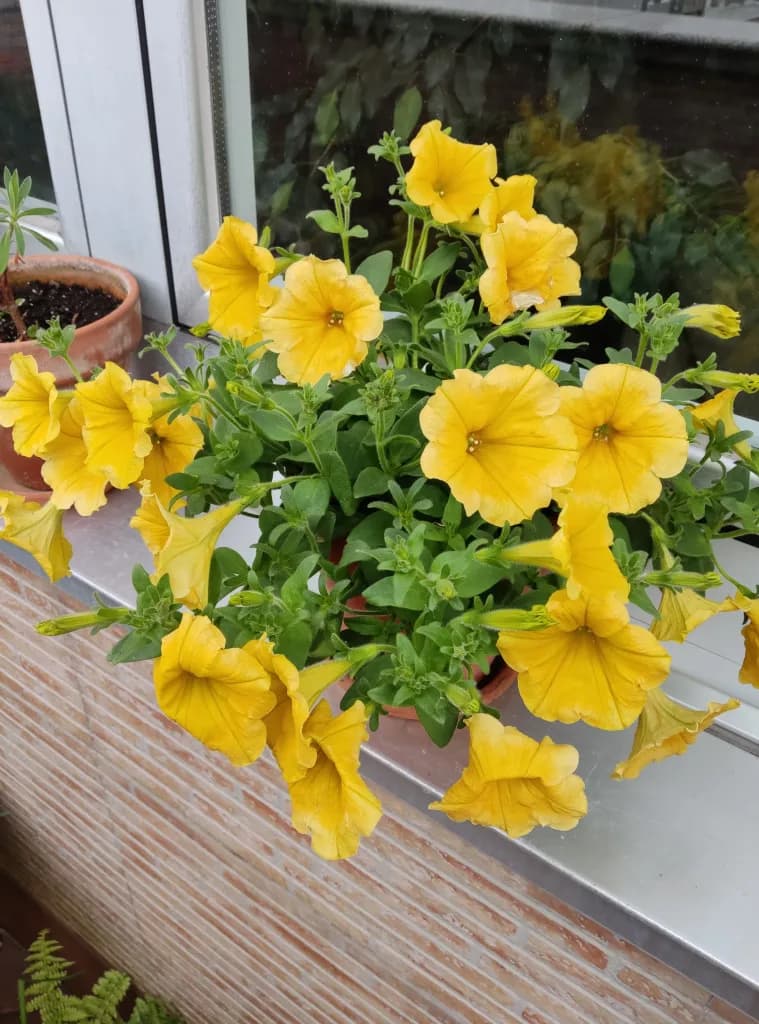
The petunia is one of the most popular and appreciated flowering plants in ornamental gardening due to its abundant and prolonged blooming. Its flowers have a characteristic funnel or trumpet shape and come in an almost infinite range of colors, with the yellow variety in the image being a bright and cheerful option. They are ideal for decorating balconies, terraces, and pots due to their compact habit and their ability to cover spaces with color from spring to autumn.
It belongs to the Solanaceae family, sharing kinship with species as diverse as the tomato or tobacco. Its origin is in the temperate and tropical regions of South America, mainly in countries like Argentina and Brazil. Most commercial varieties are complex hybrids developed to maximize climate resistance and flower quantity. Its leaves are green, velvety, and have a slightly sticky texture, a natural defensive adaptation of the species.
Regarding its cultivation, the petunia requires full sun exposure to bloom in all its splendor and regular watering that keeps the substrate moist without becoming waterlogged. It is essential to periodically remove wilted flowers to stimulate the constant production of new buds and maintain the plant's aesthetic. Although in cold climates they are usually treated as annuals due to their sensitivity to frost, in warm areas they can behave as perennials if cared for properly.
Did you know?The sticky texture of petunia foliage is produced by glandular hairs that help protect the plant by trapping and deterring small crawling insects.
Care
- Watering
- Frequent, once a day in summer, avoiding wetting flowers and leaves.
- Light
- Full sun, minimum of 6 to 8 hours of direct daily light.
- Temperature
- Ideal between 15°C and 25°C. Sensitive to frost and extreme heat.
- Soil
- Nutrient-rich, with excellent drainage and slightly acidic pH.
- Fertilizer
- Fertilizer for flowering plants every 15 days during growth.
- Pruning
- Pinch off spent blossoms together with their base to stimulate continuous flowering rather than seed production. Cut back leggy stems by roughly a third mid-season to encourage fresh, bushy growth.
- Propagation
- Easily started from seed indoors during late winter, roughly eight to ten weeks before the last frost. Softwood stem cuttings can also be rooted in water or moist potting mix during early spring.
Is Yellow Petunia toxic to cats and dogs?
No. According to the ASPCA, it is not toxic to cats or dogs.
- Cats
- Non-toxic
- Dogs
- Non-toxic
Source: ASPCA Animal Poison Control
Common problems
- Aphids
- Powdery mildew
- Botrytis (grey mould)
- Root rot
- Iron chlorosis
Common diseases
Frequently asked questions
Why is my petunia producing few or no flowers?
The most frequent reason is insufficient direct sunlight, as petunias need at least five to six hours daily to set buds. Other common causes include excess nitrogen fertilizer or leaving spent flowers on the stems to develop seeds.
How do I fix leggy and sparse petunias?
By midsummer, petunias often stretch and become bare near their centers. Prune the long stems back by about a third to prompt fresh branching and a second flush of blooms within a couple of weeks.
Why are my petunia leaves turning yellow?
If leaf blades turn yellow while veins remain bright green, the plant is likely suffering from iron chlorosis due to alkaline conditions. If entire leaves turn limp and yellow, overwatering and soggy root zones are usually the culprits.
Is it normal for petunia leaves to feel sticky?
Yes, this sticky sensation is a completely natural feature caused by glandular hairs on the foliage. It is only a concern if accompanied by visible pests like aphids or a dark coating of sooty mold.
From the same family
Growing Yellow Petunia at home?
Take a photo and we'll tell you how it's doing and what it needs.