
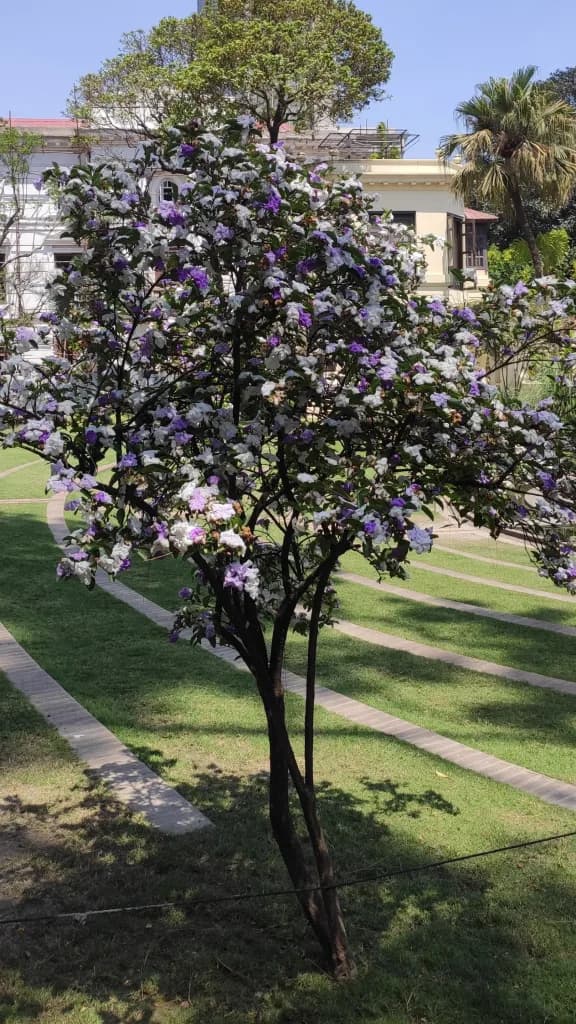
Brunfelsia pauciflora, popularly known as "yesterday, today, and tomorrow," is a prized evergreen ornamental shrub for its spectacular chromatic transformation. Its common name directly refers to the curious characteristic of its flowers, which open a deep purple (yesterday), turn lavender or lilac on the second day (today), and finish white in their final stage (tomorrow). This phenomenon allows all three colors to be seen simultaneously on the same plant, creating a vibrant and dynamic visual effect throughout spring and summer.
It belongs to the Solanaceae family, linking it with plants like tomatoes or tobacco. It originates from the rainforests and tropical forests of Brazil, where it grows under the forest canopy in high-humidity environments. Its habit is shrubby, dense, and compact, with dark, leathery green leaves that highlight the brilliance of the flowers. In warm, stable climates, it can reach up to three meters in height, although in domestic cultivation, it's often kept smaller through pruning.
In home gardens, it's a popular choice for borders or as a specimen plant due to its delicate and sweet fragrance. However, caution is essential, as all parts of the plant contain neurotoxic alkaloids, being particularly dangerous for dogs that might chew its seeds or roots. It requires acidic soils and constant moisture maintenance, being sensitive to prolonged frosts as well as hard water, which can cause its leaves to yellow.
Did you know?Its unusual name comes from its blossoms, which transition daily from purple (yesterday) to lavender (today) and finally white (tomorrow).
Care
- Watering
- 2-3 times per week; keep soil moist but not waterlogged.
- Light
- Filtered sun or partial shade; avoid intense direct sun during central hours.
- Temperature
- Ideal 15°C to 25°C; protect from strong frosts below 5°C.
- Soil
- Rich in organic matter, well-drained, and with slightly acidic pH.
- Fertilizer
- Flowering plant fertilizer every 15 days in spring-summer.
- Pruning
- Prune lightly right after the main flowering flush to maintain a bushy shape and remove old or weak stems.
- Propagation
- Propagate by taking semi-hardwood cuttings during late spring or summer. Maintain high humidity and gentle bottom heat to encourage successful rooting.
Is yesterday today tomorrow toxic to cats and dogs?
Yes. According to the ASPCA, it is toxic to cats and dogs.
- Cats
- Toxic
- Dogs
- Toxic
Usual signs: Tremors, seizures lasting several days, diarrhea, vomiting, hypersalivation, lethargy, incoordination, and coughing.
If your pet has chewed it and shows symptoms, call your vet or the nearest emergency vet.
Source: ASPCA Animal Poison Control
Common problems
- Iron chlorosis
- Root rot
- Mealybugs and scale
- Spider mites
- Cold damage
Frequently asked questions
Why do the flowers change color over time?
The color shift occurs as purple anthocyanin pigments degrade naturally as the blossom ages. Within three days, the bloom transitions smoothly from deep violet to soft lavender and ultimately white.
Why are the leaves turning yellow with green veins?
This is a classic sign of iron chlorosis, often triggered by hard tap water or alkaline soil locking out iron absorption. Treat the plant with chelated iron and adjust the potting mix to maintain an acidic pH.
Why is my Brunfelsia not blooming?
A lack of flowers usually points to insufficient light or an excess of nitrogen fertilizer over phosphorus and potassium. Move the shrub to a brighter spot with morning sun and use a bloom-boosting fertilizer.
Can this plant be grown indoors year-round?
Yes, provided it receives abundant indirect light and steady humidity. Keep it away from dry heating vents and cold drafts to avoid premature leaf drop.
From the same family
Growing yesterday today tomorrow at home?
Take a photo and we'll tell you how it's doing and what it needs.