
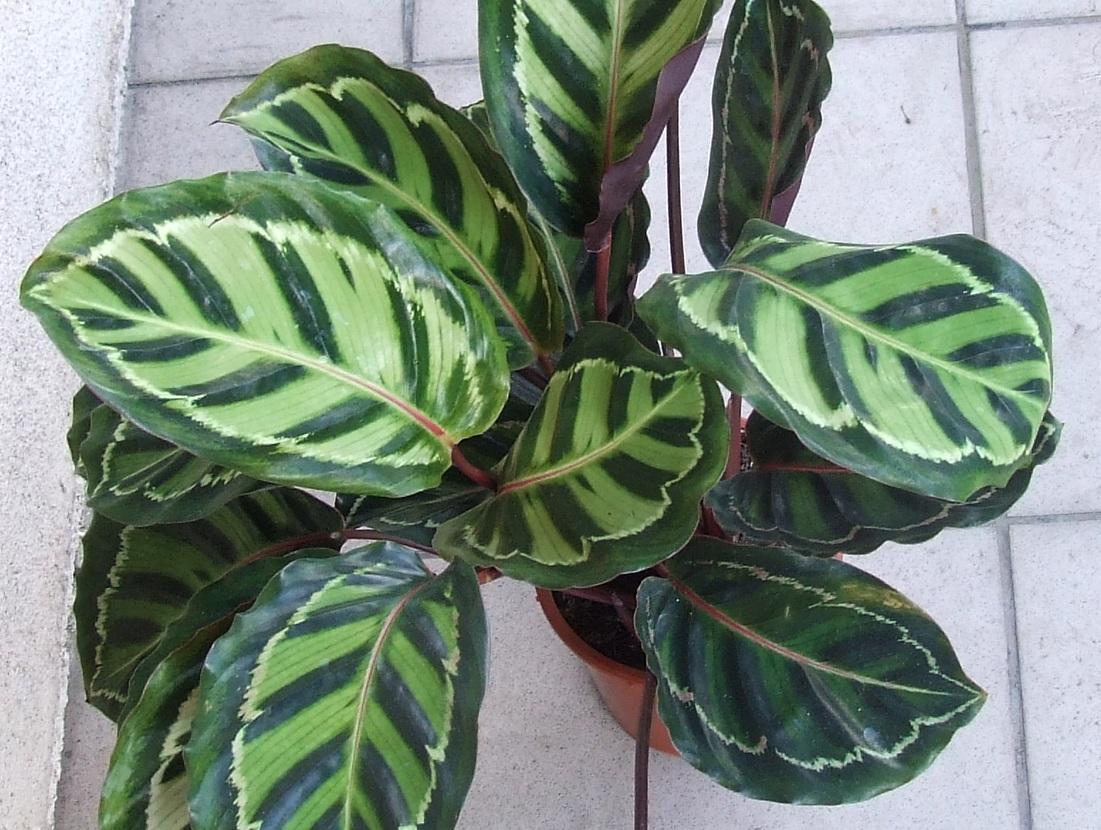
The rose-painted calathea (Calathea roseopicta) is an herbaceous plant in the Marantaceae family, celebrated for its round leaves patterned in green, cream and pink with a deep purple underside. Native to the tropical forests of northwestern Brazil and neighboring Amazon regions, it grows on the shaded forest floor where light arrives filtered and humidity stays high. Each leaf unfurls from a rolled tube and flattens into an almost circular blade of remarkable symmetry.
Indoors it is a plant for attentive growers: it wants moderate indirect light, steady warmth between 18 and 26 °C and humidity ideally above 60 %. Watering uses soft water at room temperature, keeping the soil lightly moist without ever waterlogging it. Hard tap water and dry air are its two great enemies, showing quickly as brown margins and curled leaves.
Its famous movement adds charm: at dusk the leaves rise upright and by morning they lower again, a daily rhythm called nyctinasty. Growth is slow and compact, so a healthy plant keeps its tidy rosette shape for years with little pruning. With soft water, stable warmth and generous humidity, it stays one of the most decorative foliage plants for bright interiors.
Did you know?Like all prayer plants, it raises its leaves at night and lowers them by day, following an internal rhythm.
Care
- Watering
- Keep the soil lightly moist at all times, watering when the surface just begins to dry. Use rainwater or soft water at room temperature, since hard water spots the leaves and harms the roots. Never let the pot sit in water, but do not let the root ball dry out fully either.
- Light
- It prefers moderate, indirect light, such as a bright north-facing spot or a few metres from a sunny window. Too much light fades the patterns; too little weakens growth.
- Temperature
- It grows best between 18 and 26 °C and suffers below about 15 °C. Avoid cold drafts, sudden chills and heaters that dry the air around the leaves.
- Soil
- Use a light, moisture-retentive mix with coco coir, perlite and a little pine bark. It should stay open and airy rather than compacting like heavy garden soil.
- Fertilizer
- Feed sparingly with a quarter-strength balanced fertilizer once a month in spring and summer. This species reacts badly to excess salts, so flush the pot with soft water if leaf margins brown.
- Pruning
- It needs no pruning: simply cut dry or damaged leaves at the base of the stem. Do not cut leaf tips for looks, since the cut edges dry out again.
- Propagation
- Propagate by division in spring, separating a clump with several leaves and its own roots. Plant at the same depth in a light mix and keep humidity high until it settles.
Is Rose-painted calathea toxic to cats and dogs?
No. According to the ASPCA, it is not toxic to cats or dogs.
- Cats
- Non-toxic
- Dogs
- Non-toxic
Source: ASPCA Animal Poison Control
Common problems
- Dry air
- Hard water
- Spider mites
- Salt or fertiliser build-up
Frequently asked questions
Why does my calathea have brown leaf edges?
Brown edges usually mean dry air, hard tap water or fertilizer buildup. Raise humidity above 60 %, switch to rainwater or soft water and flush the pot occasionally. Trim only the dry margins, since the damage does not reverse.
How often should I water it?
Water when the surface just starts to dry, keeping the soil lightly moist but never soggy. In summer this may be twice a week; in winter, once a week is often enough. If the leaves curl during the day, check moisture first.
Why do the leaves move up and down?
It is a natural daily rhythm: the leaves rise at night and lower by day to catch filtered light. The movement is strongest in healthy, well-watered plants. If an individual leaf stops moving and yellows, it is simply ageing.
Can I use tap water?
It depends on your area: hard or heavily chlorinated water often causes brown edges and spots. Rainwater, filtered water or rested tap water works better. If you must use tap water, let it stand open overnight before watering.
How do I propagate it?
By division in spring: separate a section with several leaves and its own roots and pot it at the same depth. Keep the division warm, shaded and humid for the first weeks. Leaf cuttings without roots do not work in this species.
From the same family


Growing Rose-painted calathea at home?
Take a photo and we'll tell you how it's doing and what it needs.