
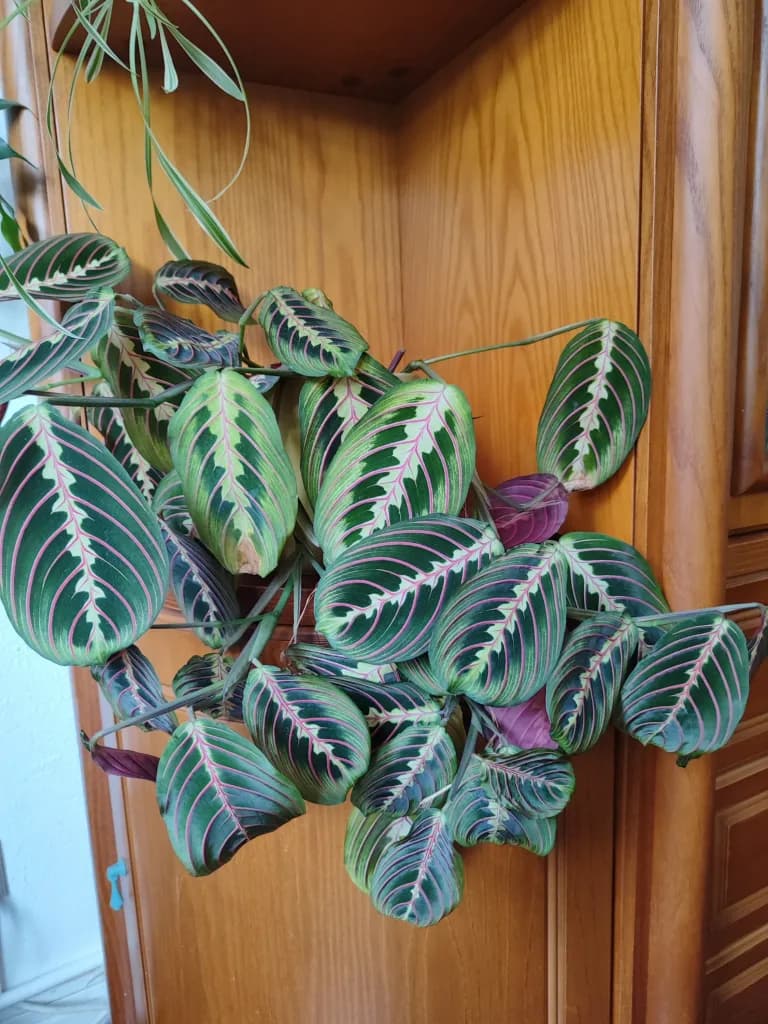
The Red Maranta is one of the most prized indoor plants for its spectacular foliage. Its oval leaves feature a fascinating pattern of deep red veins contrasting with a dark green background and lighter spots towards the center. It gets the popular name "prayer plant" due to the nyctinastic movement of its leaves, which fold upwards at night, resembling two hands in prayer to conserve moisture.
Botanically, it belongs to the Marantaceae family and originates from the tropical rainforests of Brazil. It is a perennial herbaceous plant with a creeping or trailing growth habit, spreading via rhizomes. In its natural habitat, it grows on the forest floor under the shade of larger trees, explaining its preference for very humid environments, constant warm temperatures, and filtered light. Its underside often has a very decorative purple or reddish hue visible when the leaves fold up.
Indoors, it requires constant attention to ambient humidity to prevent its edges from becoming brittle. Although it is a plant of moderate care, it is very rewarding to observe how its leaves move sensitively throughout the day seeking light. It is ideal for shelves or hanging baskets where its stems can showcase their form. Besides its aesthetic beauty, it is highly valued for being safe for homes with dogs and cats, as it is non-toxic if ingested or touched.
Did you know?It is popularly known as the "prayer plant" due to the nyctinastic movement of its leaves, which fold upwards at night.
Care
- Watering
- Keep soil moist, never waterlogged; water 2-3 times weekly in summer.
- Light
- Bright indirect light; direct sun scorches and fades leaves.
- Temperature
- Ideal range 18°C-24°C; avoid cold drafts.
- Soil
- Porous, organic-rich mix with good drainage.
- Fertilizer
- Liquid fertilizer for green plants every 15 days in spring/summer.
- Pruning
- Trim discolored or spent leaves at the soil line, and pinch back leggy stems in early spring to encourage bushier growth.
- Propagation
- Take stem cuttings just below a leaf node and root them in water or damp potting mix during spring. You can also divide large, mature plants during repotting.
Is Prayer Plant (Red Maranta) toxic to cats and dogs?
The ASPCA doesn't list this species. If your pet has chewed it and seems unwell, call your vet.
Common problems
- Dry air
- Overwatering
- Root rot
- Spider mites
- Sunburn
Common diseases
Frequently asked questions
Why are the leaf tips turning brown and crispy?
Crispy brown edges are usually caused by dry indoor air or mineral accumulation from hard tap water. Boost ambient humidity with a humidifier and switch to distilled, filtered, or rainwater.
Why is my prayer plant not folding its leaves at night?
If your plant stops moving, it may not be receiving enough daylight to establish its natural circadian rhythm, or it could be underwatered. Move it to a brighter spot with indirect light and check that the soil is lightly moist.
Why are the leaves turning yellow?
Widespread yellowing most often stems from overwatering and poor drainage, which suffocates the roots. Allow the top layer of soil to dry out before watering again and ensure the pot has drainage holes.
Does the prayer plant need to be misted daily?
While it loves high humidity, frequent foliar misting can encourage fungal leaf spotting if airflow is stagnant. Using a room humidifier or grouping it with other plants creates a healthier microclimate.
From the same family
Growing Prayer Plant (Red Maranta) at home?
Take a photo and we'll tell you how it's doing and what it needs.