
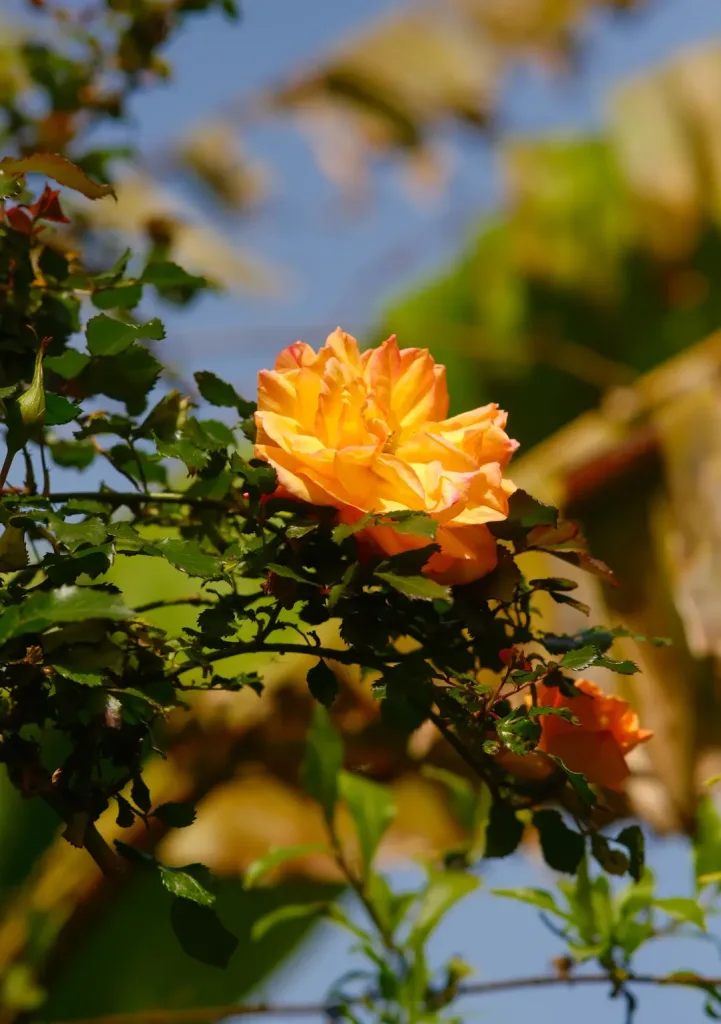
The rose bush is one of the most cherished ornamental shrubs worldwide for the beauty and fragrance of its flowers. This variety features petals with a vibrant gradient of yellow and orange colors, often with slightly pink edges, giving it a warm and luminous appearance in any garden. Its stems are thorny, and its leaves are a deep green with serrated edges, classic characteristics of its genus.
Belonging to the Rosaceae family, the genus Rosa comprises hundreds of species and thousands of hybrid cultivars. Although its origin is mainly in the temperate regions of the Northern Hemisphere, its distribution is now global thanks to centuries of hybridization. They adapt well to various climates as long as they have direct sun exposure and require deep, fertile soils with excellent drainage to thrive and avoid fungal diseases.
In addition to its aesthetic use in landscaping and floristry, roses have a long history in perfumery and traditional medicine. Their petals are often edible and used in infusions or baking. In the garden, they require annual pruning in late winter to maintain their vigor and remove old wood, as well as constant monitoring against common pests like aphids or opportunistic fungi that affect their foliage.
Did you know?Most modern garden roses stem from 19th-century crossings between European and Asian species. This historic hybridization introduced the repeat-blooming trait that garden roses are famous for today.
Care
- Watering
- 2 to 3 times per week, directly to soil, avoiding wetting leaves.
- Light
- Full sun, minimum 6 to 8 hours of direct light daily.
- Temperature
- Between 15°C and 25°C; tolerates moderate frost.
- Soil
- Rich in organic matter, deep, and with excellent drainage.
- Fertilizer
- Rose fertilizer every 20 days during the growing season.
- Pruning
- Perform main structural pruning in late winter by removing dead canes and cutting healthy stems back to an outward-facing bud. Deadhead spent blooms regularly throughout the growing season to encourage continuous reblooming.
- Propagation
- Roses are most easily propagated by semi-ripe or hardwood stem cuttings taken in late summer or autumn. Commercial cultivars are typically bud-grafted onto vigorous rootstocks to enhance overall hardiness.
Is Orange rose toxic to cats and dogs?
No. According to the ASPCA, it is not toxic to cats or dogs.
- Cats
- Non-toxic
- Dogs
- Non-toxic
Source: ASPCA Animal Poison Control
Common problems
- Black spot
- Powdery mildew
- Aphids
- Rust
- Spider mites
Common diseases
Frequently asked questions
Why are my rose leaves developing black spots and turning yellow?
This is typically black spot fungus, which thrives in wet, humid conditions on the foliage. Remove fallen infected leaves immediately, avoid overhead watering, and apply an appropriate fungicidal spray if needed.
When and how should I prune my rose bush?
Prune in late winter before new growth emerges, removing crossing, weak, and dead branches completely. Cut remaining healthy canes back by about one-third, making clean, angled cuts just above outward-facing buds.
Why is my rose bush not blooming?
The most common culprit is insufficient sunlight, as roses need at least six hours of direct sun daily to set buds. Excess nitrogen fertilizer can also promote lush green foliage at the expense of blossoms.
How do I manage aphids on the new shoots?
Rinse young shoots with a steady spray of water or apply insecticidal soap as soon as aphids appear. For persistent infestations, treat with diluted neem oil during cooler evening hours.
From the same family
Growing Orange rose at home?
Take a photo and we'll tell you how it's doing and what it needs.