
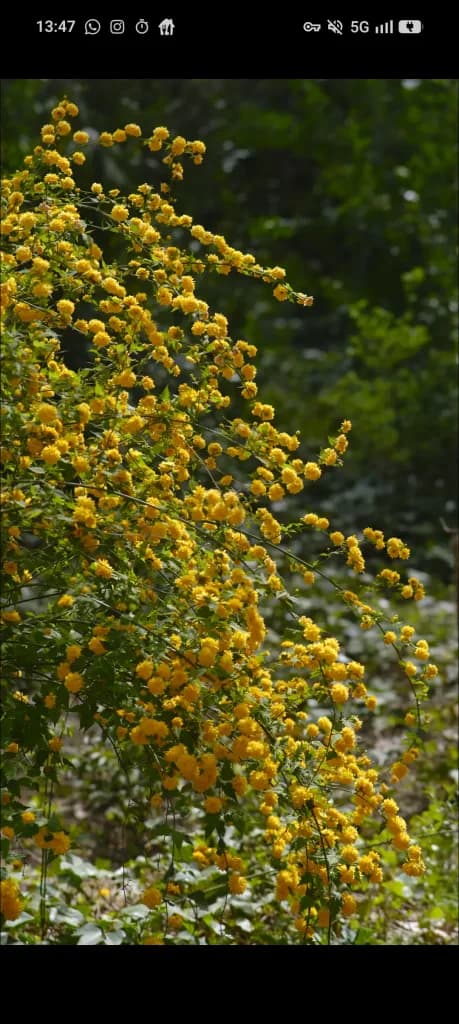
Kerria japonica, popularly known as Japanese Kerria or Coral Bells, is a deciduous shrub highly valued in landscaping for its explosive and early spring bloom. It is characterized by its slender, arching stems with a bright green color that persists even in winter, and by its flowers, which in the most common variety ('Pleniflora') resemble small, intense golden-yellow pom-poms. Its habit is graceful and elegant, typically reaching between 1.5 and 3 meters in height.
Botanically, it belongs to the Rosaceae family and is the sole species in the genus Kerria. It is native to the mountainous regions of China and Japan, where it grows naturally at the edges of forests and on shaded slopes. It prefers temperate climates and soils that retain some moisture, showing great resistance to extreme cold. Its leaves are alternate, lanceolate, and with markedly serrated margins, giving it a visually attractive texture throughout the growing season.
In the garden, it is an extremely rewarding and low-maintenance plant, ideal for forming informal hedges or brightening shady corners where other plants do not flower well. A curious fact is that the double-flowered variety was the first to be introduced to the West, leading to the mistaken belief for years that this was the natural form of the species, when in reality the wild form has simple, five-petaled flowers. It is a plant that propagates easily through the suckers that emerge from its base.
Did you know?Its slender stems remain a bright, vibrant green through winter, providing outstanding visual interest long after the leaves have dropped.
Care
- Watering
- 2-3 times/week, keeping soil fresh but not waterlogged.
- Light
- Partial shade preferred; full sun reduces flower intensity and longevity.
- Temperature
- 15-25°C ideal; tolerates heavy frost down to -15°C.
- Soil
- Fertile, rich in organic matter, well-drained, neutral to acidic pH.
- Fertilizer
- Granular organic or balanced fertilizer at the start of spring every 30 days.
- Pruning
- Prune directly after the spring flowering period finishes by cutting back flowered stems and thinning out one-third of the oldest canes near ground level. This selective pruning promotes vigorous new shoots that will bear next season's flower buds.
- Propagation
- Multiply the shrub easily by digging up and replanting rooted suckers that emerge from the base during winter dormancy. You can also take semi-ripe cuttings in early summer and root them in moist, sheltered potting mix.
Is Japanese Kerria toxic to cats and dogs?
The ASPCA doesn't list this species. If your pet has chewed it and seems unwell, call your vet.
Common problems
- Fungal or bacterial leaf spots
- Powdery mildew
- Aphids
- Sunburn
- Root rot
Frequently asked questions
Why are my Japanese kerria flowers fading to pale yellow?
Kerria blossoms bleach quickly when subjected to harsh, direct midday sunlight. Growing the plant in partial or dappled shade keeps the flower petals rich in golden color throughout their blooming period.
When and how should I prune Japanese kerria?
Prune immediately after the spring bloom concludes, never during autumn or late winter. Cut back spent stems to healthy buds and take down the thickest old canes to ground level to maintain vigor and good form.
Why is my Japanese kerria failing to bloom?
The most frequent issue is pruning late in the year, which removes the dormant flower buds set for the coming spring. Excessive nitrogen fertilizer, which forces leafy shoots instead of buds, or excessively deep shade can also limit flowers.
How can I keep Japanese kerria from spreading too wide?
Japanese kerria spreads naturally through underground root suckers that expand the main clump over time. You can easily restrict its footprint by severing and removing unwanted root shoots with a spade each spring.
From the same family
Growing Japanese Kerria at home?
Take a photo and we'll tell you how it's doing and what it needs.