
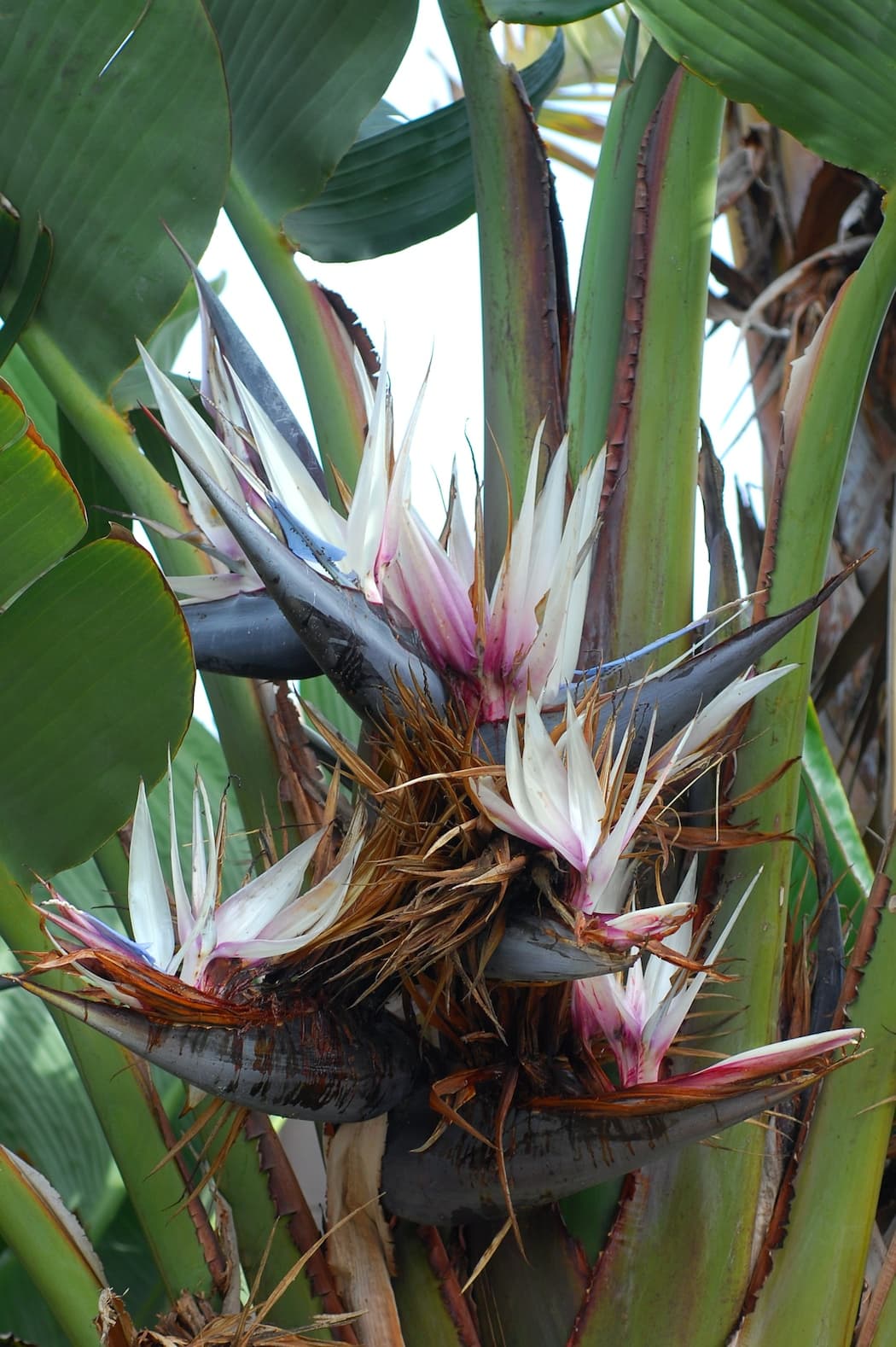
The white bird of paradise (Strelitzia nicolai) is a striking, large-growing perennial native to coastal forests of eastern South Africa. In its native habitat it can grow over six meters tall, forming dense clumps with woody stems, but it is widely cherished worldwide as an architectural houseplant thanks to its huge paddle-shaped leaves that create an instant jungle atmosphere.
Over time, its leaves naturally split along the lateral veins in response to air movement, a built-in defense mechanism that prevents the plant from being torn out by strong winds. While outdoor specimens in warm regions produce fascinating bird-like blooms in shades of cream and deep blue, indoor container plants are grown almost exclusively for their bold, glossy foliage.
This is a vigorous grower under bright conditions that develops thick, fleshy roots capable of cracking light plastic pots. To keep it healthy indoors, place it in an expansive container with good drainage, clean its large leaves periodically to remove dust, and protect it from cold drafts.
Did you know?The dramatic tears in its leaves are an evolutionary adaptation that lets wind blow right through without snapping the foliage.
Care
- Watering
- Water thoroughly once the top two inches of soil have dried out. This typically means watering about once a week during summer and every ten to fourteen days in winter, always avoiding waterlogged pots.
- Light
- It requires abundant bright light and easily tolerates several hours of direct morning or late afternoon sun. Low light will lead to weak, floppy stems and stunted growth.
- Temperature
- Thrives best between 18 °C and 28 °C. Keep it away from cold drafts and avoid exposure to sustained temperatures below 10 °C.
- Soil
- A chunky, well-draining potting mix containing peat moss or coco coir, perlite, and coarse bark ensures strong root health without water retention issues.
- Fertilizer
- Feed with a balanced liquid houseplant fertilizer every two weeks through spring and summer, pausing applications during the dormant winter months.
- Pruning
- Trim off older, lower leaves at the base using clean pruning shears when they turn dry or yellow.
- Propagation
- Best propagated by dividing mature root clumps or offshoots during springtime repotting. Growing from fresh seeds is possible, though it requires warm temperatures and patience.
Is White bird of paradise toxic to cats and dogs?
The ASPCA doesn't list this species. If your pet has chewed it and seems unwell, call your vet.
Common problems
- Root rot
- Overwatering
- Spider mites
- Mealybugs and scale
- Dry air
- Too little light
Frequently asked questions
Why are the leaves on my white bird of paradise splitting?
Leaf splitting is a normal biological trait of this plant. In the wild, it allows heavy wind to pass through the leaves without toppling or tearing the main stalk.
What causes brown and crispy edges on the foliage?
Brown edges usually indicate dry indoor air, drafty vents, or inconsistent watering. Increasing room humidity and keeping a regular watering routine helps prevent dry margins.
Will my white bird of paradise bloom indoors?
It rarely blooms indoors because it requires extreme sunlight, maturity, and soil volume to set flowers. Most indoor specimens are grown purely for their dramatic leaves.
Why are my plant's lower leaves turning yellow?
A single yellow leaf at the bottom is usually just normal aging. Multiple yellowing leaves at once, however, typically point to overwatering or poorly draining soil suffocating the roots.
Growing White bird of paradise at home?
Take a photo and we'll tell you how it's doing and what it needs.