
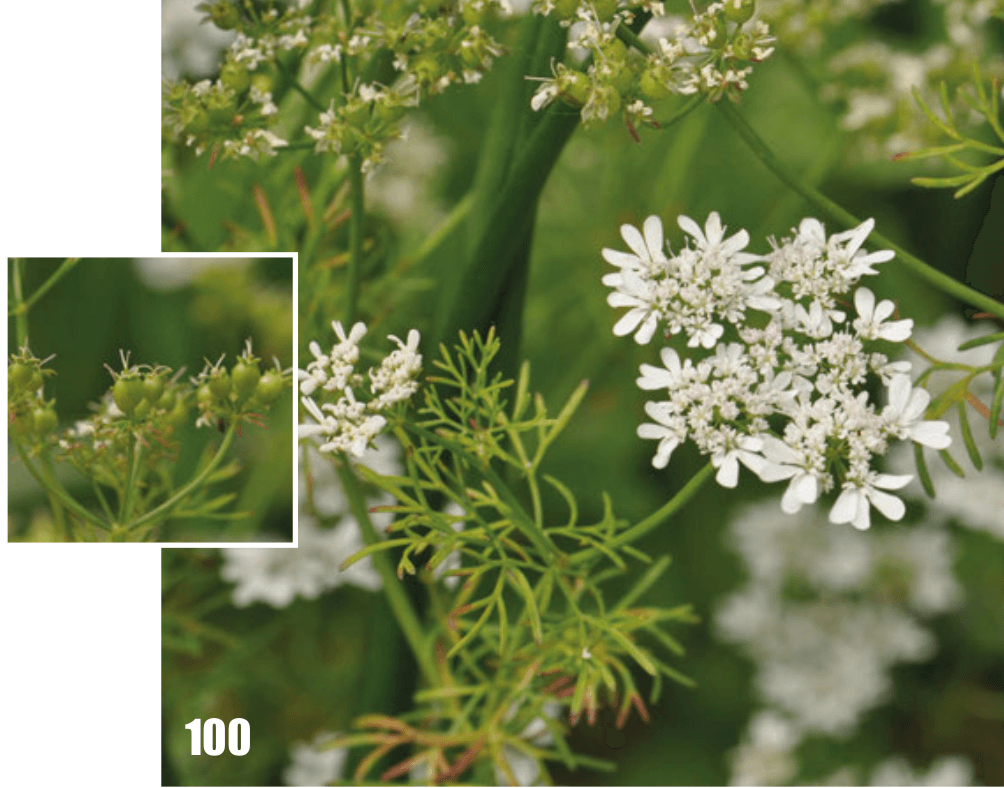
Coriander (Coriandrum sativum), commonly known as cilantro across the Americas, is a fast-growing annual herb belonging to the carrot family (Apiaceae). Revered globally for its bright flavor and aromatic foliage, the plant forms compact basal rosettes of tender, divided leaves. As the season progresses, it sends up slender flowering stems topped with delicate umbels of small white or pale pink flowers.
This versatile culinary herb thrives in window boxes, balcony containers, and kitchen garden beds. It develops a fragile taproot that resents root disturbance, which means it rarely adapts well to bare-root transplanting and performs best when sown straight into its permanent pot. Coriander prefers temperate weather conditions and tends to bolt rapidly whenever stressed by excessive summer heat or dry periods.
To enjoy a continuous harvest of flavorful green leaves, pick outer stems frequently and pinch back the earliest flower shoots. Providing the plant with several hours of bright light, moderate temperatures, and evenly moist potting soil will keep your foliage lush and aromatic throughout its growth cycle.
Did you know?Every part of the coriander plant is edible; while the green leaves are used as a fresh herb, the dried round seeds are ground into a warm, citrusy spice.
Care
- Watering
- Keep the potting mix evenly moist without letting it become soggy, watering roughly 2 to 3 times a week depending on the weather. Check the soil with your fingertip and add water as soon as the top inch feels dry.
- Light
- It requires ample bright light and thrives with 4 to 6 hours of gentle direct sun, ideally in the morning. In hot summer climates, provide light afternoon shade to shield the foliage from intense midday heat.
- Temperature
- It grows best in moderate temperatures between 15 °C and 22 °C (59 °F to 72 °F). While it tolerates cooler spells, continuous heat above 28 °C quickly triggers bolting and turns the foliage bitter.
- Soil
- Use a light, fertile, and well-draining potting soil amended with perlite and organic compost.
- Fertilizer
- It does not need heavy feeding; a light dose of balanced liquid organic fertilizer once a month during active growth is plenty.
- Pruning
- Harvest older outer stems down at the base to encourage new growth from the center, and promptly snip off emerging flower buds.
- Propagation
- Propagate by sowing seeds directly into the final container in spring or early autumn. Kept moist in mild temperatures, seeds typically sprout in 10 to 14 days.
Is Coriander toxic to cats and dogs?
No. According to the ASPCA, it is not toxic to cats or dogs.
- Cats
- Non-toxic
- Dogs
- Non-toxic
Source: ASPCA Animal Poison Control
Common problems
- Aphids
- Powdery mildew
- Root rot
- Underwatering
- Transplant shock
Frequently asked questions
Why is my coriander bolting and flowering so quickly?
Coriander naturally bolts in response to high heat, dry soil, or lengthening summer days as part of its life cycle. You can delay flowering by keeping the plant in cool afternoon shade and watering consistently.
How should I harvest coriander to keep it growing?
Snip the outer stems near the base using clean scissors, leaving the central growing point untouched. This encourages the plant to continuously generate fresh, tender leaves from the crown.
Why are the leaves on my coriander turning yellow?
Yellowing leaves are usually caused by overwatering or poor drainage that deprives roots of oxygen. It can also point to nutrient depletion if the plant has been growing in the same small pot without supplemental feed.
Can I transplant coriander into a larger pot?
Coriander has a sensitive taproot that suffers easily from transplant shock, often triggering immediate bolting. If repotting is necessary, move the root ball entirely intact without disturbing the surrounding soil.
Growing Coriander at home?
Take a photo and we'll tell you how it's doing and what it needs.