
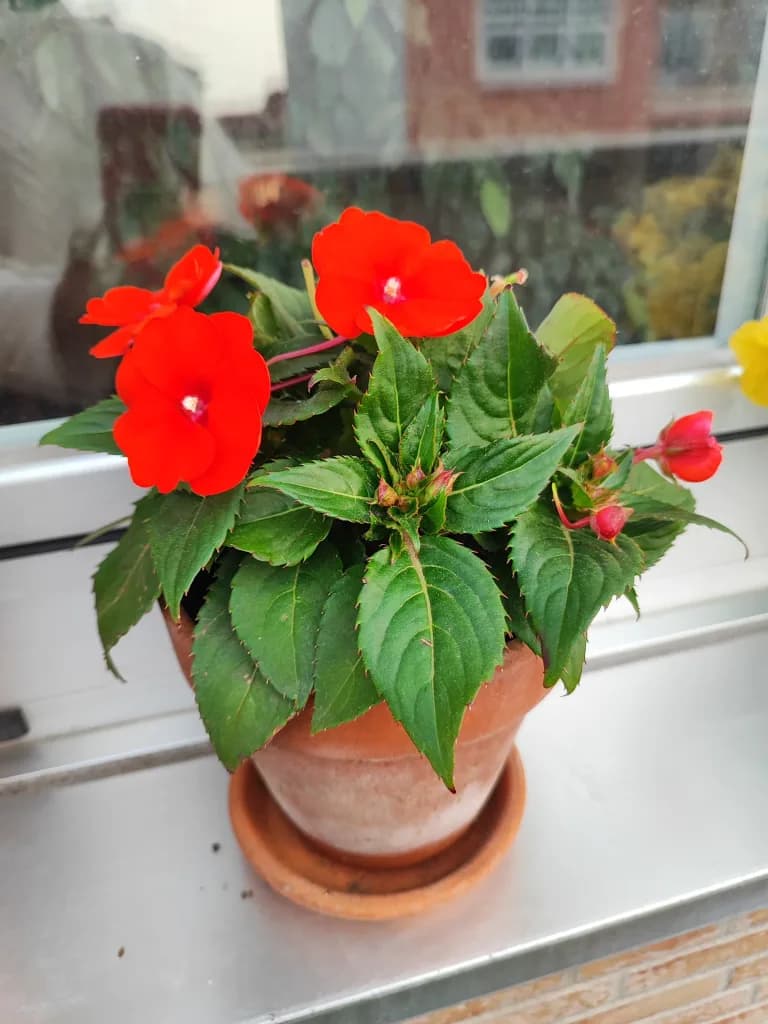
The Busy Lizzie is an ornamental plant highly valued for its intensely colored flowers and eye-catching foliage. Its leaves are lanceolate, with clearly serrated edges and a somewhat fleshy texture, displaying a dark green color that highlights the vibrancy of its petals. The flowers have five petals and a characteristic slender spur at the back, blooming generously for most of the year if provided with adequate light.
It belongs to the Balsaminaceae family and is native to the tropical rainforests of New Guinea. In its natural habitat, it thrives in environments with high humidity and light filtered by the forest canopy. Unlike other Impatiens varieties, this species has been hybridized to offer greater resistance to moderate sun exposure and a more robust, compact structure, ideal for pot cultivation.
It is a favorite choice for decorating bright interiors and balconies due to its ease of maintenance. It is considered an excellent alternative to the traditional impatiens for its greater resistance to certain fungal diseases. A curious fact about its genus is its seed dispersal mechanism: when the capsules are mature, they explode on the slightest physical contact, launching seeds several meters away.
Did you know?The Impatiens genus has a seed dispersal mechanism where ripe seed capsules burst on minimal contact, launching seeds several meters.
Care
- Watering
- Frequent, keep soil moist but avoid waterlogging.
- Light
- Bright indirect light or partial shade. Avoid direct sun.
- Temperature
- Ideal between 18-24°C. Protect from frost and extreme heat.
- Soil
- Rich, light, and well-draining.
- Fertilizer
- Liquid fertilizer for flowering plants every 15 days in spring.
- Pruning
- Pinch back young stem tips to encourage bushier growth and promptly deadhead spent flowers to stimulate new buds.
- Propagation
- Propagate easily by taking 8 to 10 cm stem cuttings during spring or summer. They root readily in either water or a damp, sterile potting mix within a few weeks.
Is Busy Lizzie toxic to cats and dogs?
No. According to the ASPCA, it is not toxic to cats or dogs.
- Cats
- Non-toxic
- Dogs
- Non-toxic
Source: ASPCA Animal Poison Control
Common problems
- Underwatering
- Root rot
- Thrips
- Spider mites
- Sunburn
Frequently asked questions
Why is my New Guinea impatiens suddenly wilting?
Severe wilting is usually caused by dry soil, as the tender stems collapse rapidly when moisture drops. However, if the soil is soaking wet, wilting indicates root rot caused by poor drainage.
Why is my plant not blooming?
Insufficient light is the most common reason, as it requires plenty of bright, indirect sunlight to form buds. Excessive nitrogen fertilization can also promote lush foliage at the expense of flowers.
Can New Guinea impatiens survive outdoors year-round?
Only in mild, frost-free climates where temperatures consistently remain above 10 °C. In colder zones, bring it indoors before autumn chills arrive or grow it as a warm-season annual.
Why are the lower leaves turning yellow and falling off?
This typically signals overwatering or root distress from waterlogged soil. Check that your container has drainage holes and allow the top layer of soil to dry slightly before watering again.
Growing Busy Lizzie at home?
Take a photo and we'll tell you how it's doing and what it needs.