
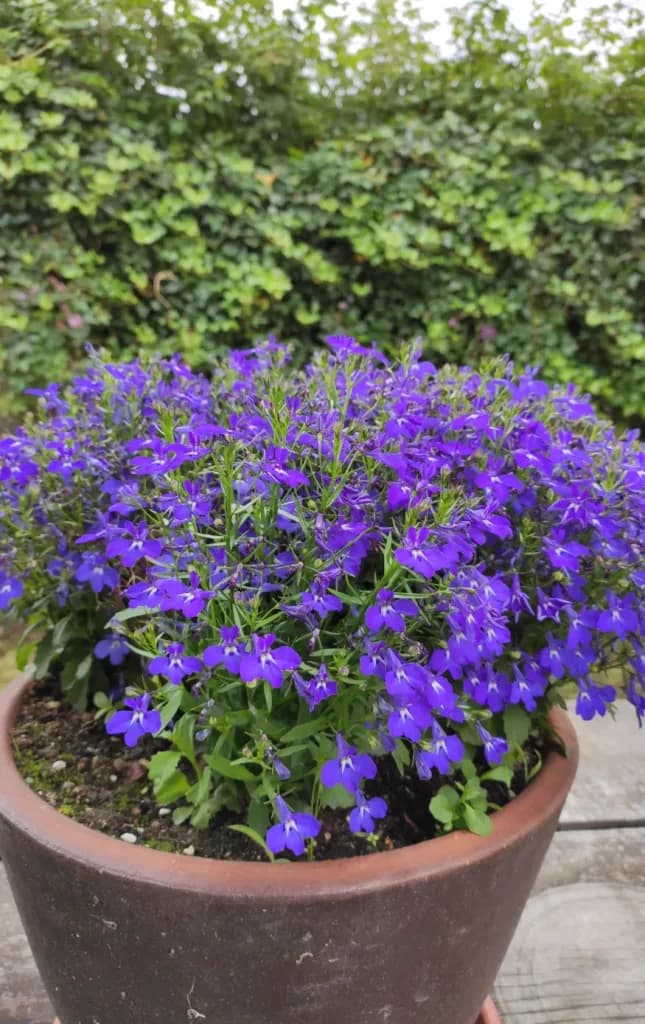
The blue lobelia is one of the most appreciated herbaceous plants in gardening for its spectacular and dense flowering. It is characterized by a trailing or bushy habit, forming compact mounds that are almost completely covered with small, vibrantly colored flowers, predominantly intense shades of blue, purple, and violet. Its leaves are small, alternate, and dark green, creating a very elegant visual contrast with the floral mass that is maintained throughout much of the warm season.
Scientifically named Lobelia erinus, this species belongs to the Campanulaceae family. It is native to the southern region of Africa, specifically South Africa, where it grows naturally in areas that retain some moisture. Although it can behave as a perennial in its natural habitat, in most temperate climates it is cultivated as an annual plant due to its sensitivity to winter frosts. Its compact and low growth habit makes it ideal for borders, rock gardens, and pots.
It is widely used in hanging baskets and balcony pots due to its growth habit that tends to spill over the edges of containers. It requires well-drained soils and adequate sun exposure, although it appreciates protection from partial shade during extremely hot summers to prevent the plant from drying out prematurely. It is important to handle it with caution, as it contains alkaloids like lobeline, which are toxic if ingested, although it is an excellent attractant for beneficial pollinators.
Did you know?Although famous for producing rare true-blue flowers, cultivated varieties also come in purple, pink, and pure white shades.
Care
- Watering
- Frequent, keep soil moist but not waterlogged, every 2 days in summer.
- Light
- Full sun or partial shade; requires at least 6 hours of direct sunlight.
- Temperature
- Ideal 15-25°C; protect from intense frost and extreme heat.
- Soil
- Rich in organic matter, light, fertile, and with excellent drainage.
- Fertilizer
- Liquid fertilizer for flowering plants every 15 days in spring-summer.
- Pruning
- Shear the plant back by half in midsummer when the initial wave of blooms begins to fade. This tidy trim removes old seed heads and revitalizes the foliage for a vibrant second flush in late summer and autumn.
- Propagation
- Propagate from seed started indoors in late winter roughly eight to ten weeks before the final frost date. Since the seeds are extremely fine, gently press them into damp seed-starting mix without covering them, as they need light to germinate.
Is Blue Lobelia toxic to cats and dogs?
The ASPCA doesn't list this species. If your pet has chewed it and seems unwell, call your vet.
Common problems
- Underwatering
- Root rot
- Spider mites
- Aphids
- Botrytis (grey mould)
Frequently asked questions
Why does edging lobelia stop blooming in midsummer?
High heat and dry conditions cause edging lobelia to slow down flower production to conserve energy. Shearing the plant back by half, keeping the soil moist, and offering afternoon shade will encourage fresh blooms in autumn.
Is edging lobelia an annual or a perennial?
It is botanically a tender perennial in frost-free climates, but it is treated almost everywhere as a summer annual. It rarely survives freezing winters and is typically replaced each spring with fresh nursery starts or seedlings.
Can edging lobelia be grown indoors?
It is not well suited for long-term indoor cultivation because it requires bright direct sunlight and natural outdoor airflow. Plants grown inside usually stretch, turn leggy, and produce very few flowers.
What are the signs of overwatering in edging lobelia?
Overwatering causes stems to turn mushy, lower leaves to yellow, and roots to rot beneath the soil surface. Always ensure pots have drainage holes and empty standing water from saucers promptly after watering.
Growing Blue Lobelia at home?
Take a photo and we'll tell you how it's doing and what it needs.